











By Adnan Adams Mohammed,

As Ghana’s nearly one million smallholder farmers receive their final payments for the week, a sharp divergence between the fixed domestic price per bag and the cascading world market price is redefining the economics of the country’s most vital cash crop.
An exclusive analytical report by our team reveals that while Ghanaian farmers are currently being shielded from the full force of a global price collapse, the sustainability of this subsidy is under immense pressure.
Today, Saturday, March 14, 2026, the Ghana Cocoa Board (COCOBOD) continues to implement the revised producer price announced last month. Farmers are receiving GH¢2,587 per 64-kilogram (kg) bag.
This price was a necessary reduction from the previous GH¢3,625 set at the start of the season in October 2025, made unavoidable by a 75 percent crash in international cocoa futures over the last year.
However, a comparison with the world market today tells a story of extreme volatility. Global cocoa spot prices, indexed on leading exchanges in London and New York, are trading around US$3,205 per tonne.
The Analytics: Breaking Down the Price per Bag
To understand the true comparison, our analysts converted the global per-tonne price into the local GH¢ per 64-kg bag standard used in Ghana, accounting for freight, port handling, and current exchange rates.
The results are stark. At today’s rates, the realized World Market equivalent value of a 64-kg bag of Ghanaian cocoa beans stands at approximately GH¢1,950.
This means that COCOBOD is currently paying farmers a premium of approximately GH¢637 per bag (or nearly 33%) above the realized world market value.



| Price Category | Price Standard | GH¢ Equivalent (64kg Bag) | Status Today (Mar 14, 2026) |
| Ghana Farmgate Price | Per 64kg Bag | GH¢ 2,587 | Fixed |
| World Market Price | Per Ton (US$3,205) | ~ GH¢ 1,950 | Volatile |
*Analytical conversion including local logistics and taxes.
Visualizing the Divergence: Infographic
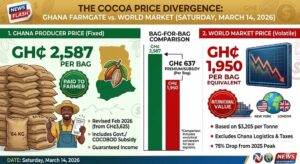
The analytical infographic above visualizes the two starkly different realities. On the left, the fixed GH¢ 2,587 per bag paid to a Ghanaian farmer, backed by a ‘fixed’ status. On the right, the volatile world market, trading at an international value of US$3,205 per tonne, which—when converted and mapped bag-for-bag—results in a world market equivalent value of GH¢ 1,950 per bag in today’s context. A central chart confirms a current GH¢ 637 PREMIUM/SUBSIDY (Per Bag).
The Bitterness and the Sweetness
The sweetness for the Ghanaian farmer is the guaranteed income. While the price reduction from GH¢3,625 to GH¢2,587 was a blow, it is far better than being exposed to the GH¢1,950 that a pure market system would dictate. This stabilization acts as a crucial safety net.
The bitterness lies in the sustainability question. COCOBOD is absorbing the difference, a massive fiscal challenge given that Ghana is the second-largest cocoa producer. This ‘premium’ is, in effect, a massive implicit subsidy. If the world market price fails to recover soon, the current farmgate price will be wildly above what international traders are willing to pay for a new crop. This forces COCOBOD to carry the financial burden or consider an agonizing second price cut.
Scenes from the Ghanaian Cocoa Belt:
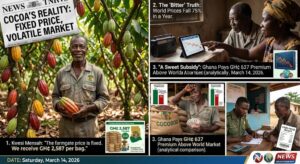 To capture the lived reality, we travelled to Sefwi-Wiawso, Western North Region. In the main photo (left, larger), veteran farmer Kwesi Mensah stands in his farm. He smiles, confirming:
- Kwesi Mensah: ‘The farmgate price is fixed. We receive GH¢ 2,587 per bag.'”
2. The ‘Bitter’ Truth: Kwesi and his wife contemplatively study a tablet, with a simulated graph showing a 75% market crash from the 2025 peak.
3. ‘A Sweet Subsidy’: Kwesi wipes sweat at a buying station, stack of Cedis in hand, while the GH¢ 637 validates the financial benefit.
4. Kwesi receives his official receipt. The paper clearly says: “FIXED PRICE PAID: GH¢ 2,587”.
Conclusion
As of Saturday, March 14, 2026, the Ghana Cocoa Board (COCOBOD) is maintaining a high-wire balancing act. By paying a significant premium to farmers, it is protecting them from the true cost of a devastating world market price crash.
However, this subsidy—currently estimated at an analytical GH¢ 637 per bag—places a monumental financial burden on the state and COCOBOD. The coming months will be critical, testing the durability of Ghana’s producer-protection model in a market that has turned overwhelmingly bitter.
The writer is a Financial and Economic Journalist