
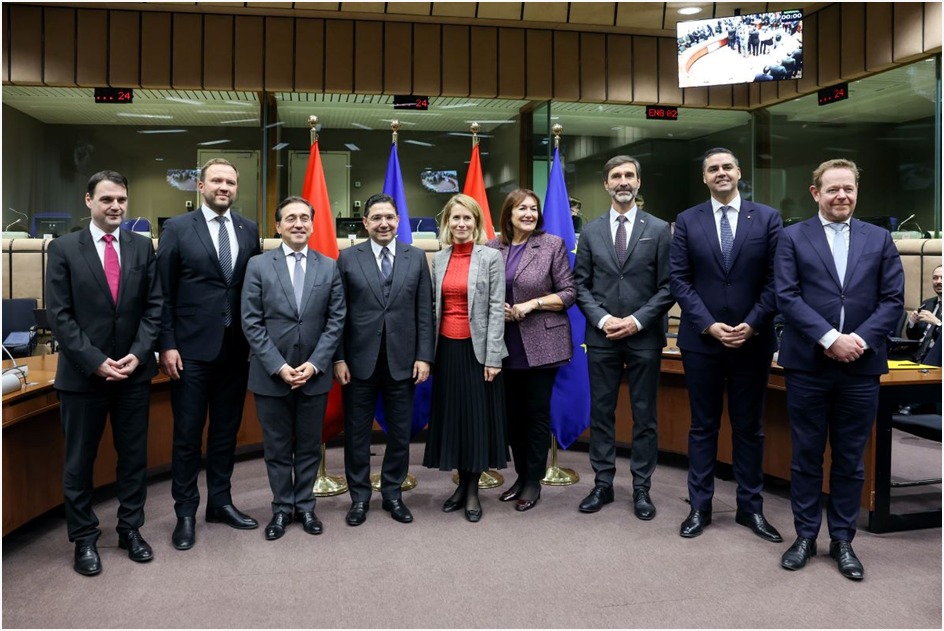
Morocco and the European Union signaled a decisive shift in their relationship on Thursday, moving beyond traditional neighborhood cooperation toward a deeper strategic alliance built on shared interests, political alignment, and long-term geopolitical convergence.
The signal emerged from the 15th session of the Morocco–EU Association Council, held in Brussels nearly 30 years after the signing of the Association Agreement and the first such high-level meeting since 2019. Against a backdrop of global instability, regional conflicts, and mounting strategic pressures, the Council was widely seen as a political relaunch of bilateral relations.
Ahead of the meeting, the European Union emphasized its determination to strengthen cooperation with Morocco in response to common regional and international challenges. EU officials highlighted priority areas such as migration management, security, and counter-terrorism, while acknowledging Morocco’s active role in multilateral diplomacy, including within the UN Human Rights Council.
Discussions covered major international dossiers, notably Ukraine, the Middle East, Gaza, and the Sahel, with Gaza described as a priority issue. The EU also pointed to Morocco’s recognized experience in combating terrorism and radicalization, underlining the Kingdom’s growing role as a security partner beyond its immediate neighborhood.
For Morocco, the Association Council carried strong political and strategic significance. Foreign Minister Nasser Bourita stressed the “positive and promising prospects” of the partnership, recalling that Morocco has long stood at the forefront of the EU’s relations with its southern neighborhood.
He underlined Morocco’s position as the European Union’s leading trading partner south of the Mediterranean and in Africa, presenting the relationship as a reference point for Europe’s broader engagement with the region. In an increasingly volatile international environment, Moroccan officials framed the Kingdom as a stable and predictable partner, offering continuity, visibility, and reliability to its European counterparts.
Beyond forward-looking statements, the Council also highlighted the resilience of the Morocco–EU partnership. Despite repeated attempts to undermine or destabilize the relationship in recent years, both sides presented a united front, demonstrating what officials described as a solid and enduring alignment.
This resilience was illustrated by the revised agricultural agreement, already in force since October, which explicitly includes Morocco’s southern provinces in EU tariff preferences. Rather than weakening the partnership, successive legal, political, and diplomatic challenges appear to have reinforced cooperation and consolidated mutual trust.
In a substantive address during the Council, Bourita called for a qualitative shift in Morocco–EU relations, arguing that decades of cooperation have transformed Morocco into a natural extension of Europe’s geopolitical and economic space. He urged a move away from a purely neighborhood-based approach toward a logic of alliance.
According to the Moroccan vision, the next phase of the partnership should be structured around strategic convergence rather than fragmented programs, supported by:
• Regular, high-level political dialogue, institutionalized at senior level;
• Joint investments in priority sectors such as industry, digital transformation, connectivity, and green energy;
• Advance consultation mechanisms, allowing Morocco to be associated upstream with EU decision-making on issues directly affecting shared interests.
While reaffirming Morocco’s readiness for regulatory convergence and shared responsibility, Bourita stressed that any deepened partnership must rest on mutual recognition, predictability, and balanced governance.
One of the most consequential political outcomes of the Association Council was the consolidation of a new European consensus on the Moroccan Sahara. For the first time, the European Union’s 27 member states aligned unanimously behind Morocco’s Autonomy Plan as the sole basis for a political solution, in line with United Nations Security Council Resolution 2797.
The shift was widely interpreted in Rabat as a major diplomatic breakthrough, marking the end of European ambiguity on the issue and reinforcing Morocco’s long-standing position on territorial integrity. It was also seen as the culmination of a patient and sustained diplomatic strategy led at the highest level of the Moroccan state.
Both sides stressed that the Association Council was not a routine institutional meeting but the political launch of a post-“Advanced Status” phase in Morocco–EU relations. The strong European participation—including senior EU officials and several foreign ministers—was viewed as tangible recognition of Morocco’s unique strategic role.
Looking ahead, the two sides agreed to move toward:
• A regular, high-level political dialogue to steer the partnership;
• A mandate to negotiate a New Enhanced Strategic Partnership, with a more ambitious roadmap covering security, industry, digital transformation, and investment;
• Formal recognition of Morocco’s distinct role as a Mediterranean leader, a pillar of stability in Africa—particularly through its Atlantic Initiative—and a key diplomatic actor for peace in the Middle East.
As Morocco and the European Union prepare to shape this new framework, the tone emerging from Brussels points to a relationship increasingly defined by strategic interdependence rather than assistance, and by long-term vision rather than transactional cooperation.
After three decades of institutional ties, both sides now appear poised to redefine their relationship—not as neighbors linked by proximity alone, but as partners jointly shaping a shared geopolitical space across the Mediterranean.
Brussels, January 29, 2026