
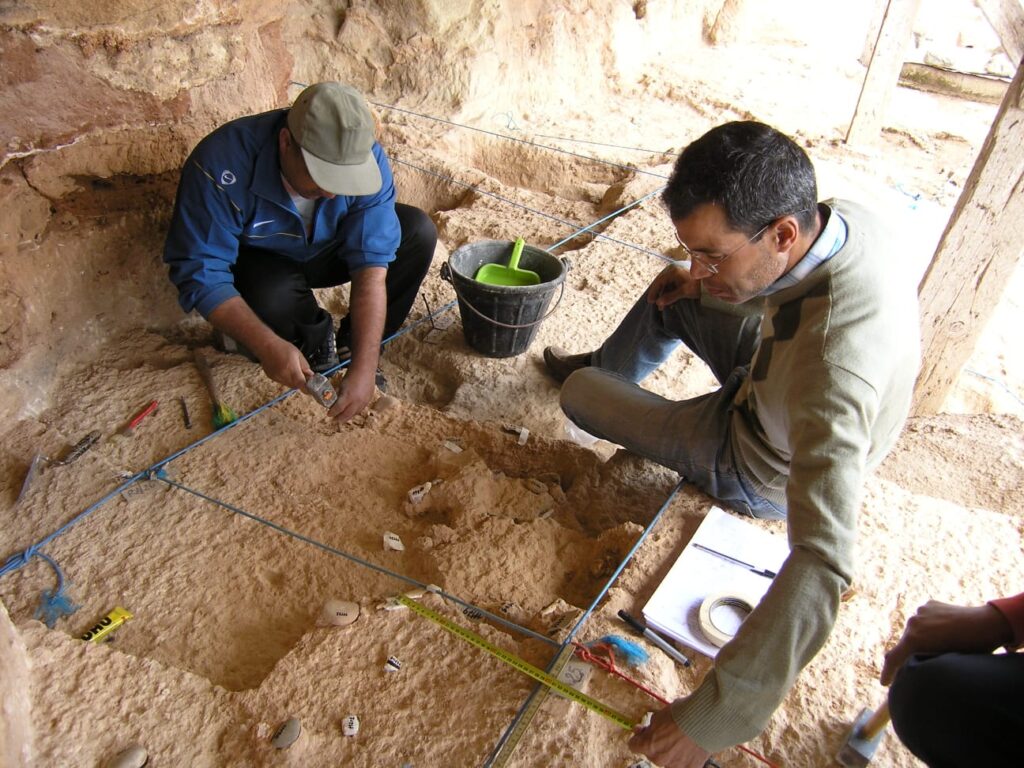
Human fossils recently uncovered in a cave at the Thomas I quarry near Casablanca are providing unprecedented insight into a pivotal period of human evolution dating back approximately 773,000 years. The discoveries, made within the framework of a long-standing Moroccan–French scientific collaboration, fill a major gap in Africa’s fossil record and underscore the central role of North Africa in early human history.
The announcement was made by Morocco’s Ministry of Youth, Culture and Communication following the publication, on January 7, 2026, of a study in the prestigious journal Nature. The research forms part of the Prehistory of Casablanca programme, an institutional partnership between Morocco’s Institut National des Sciences de l’Archéologie et du Patrimoine (INSAP) and France’s Ministère de l’Europe et des Affaires étrangères, conducted through the French archaeological mission “Casablanca”.
The material analysed includes several human mandibles, belonging to two adults and one child, as well as dental and post-cranial remains. Morphological analysis reveals a unique combination of archaic features, comparable to those seen in Homo erectus, alongside more derived, modern traits associated with later human forms.
One of the study’s most significant contributions lies in the extraordinary precision of its dating. Using high-resolution magnetostratigraphic analysis—unprecedented for a site yielding hominin remains—the researchers identified within the sediments the record of the Matuyama–Brunhes geomagnetic reversal, dated to 773,000 years ago. This provides one of the most robust and reliable ages ever established for a human fossil site in Africa.
These fossils document human populations that remain poorly known for this critical interval, which lies between early members of the genus Homo and more recent evolutionary lineages. The findings coincide with a period during which palaeogenetic data place the divergence between the African lineage leading to Homo sapiens and the Eurasian lineages that later gave rise to Neanderthals and Denisovans.
The distinctive mix of primitive and derived traits observed in the Casablanca fossils suggests populations closely associated with this major evolutionary divergence, offering a crucial reference point for understanding the emergence of modern humans.
Beyond their scientific importance, the discoveries confirm the deep African roots of our species and highlight the long-underestimated role of North Africa in major stages of human evolution. The “Hominid Cave” at the Thomas I quarry now stands as a key reference site for research into early human populations on the African continent.


Casablanca, January 7, 2026